
The Eucharist is often described as the “source and summit of Christian life”, a phrase which comes from the Second Vatican Council document on the Liturgy. It means that on the one hand every aspect of our lives of faith takes its nourishment, inspiration, strength and purpose from the Eucharist as source – prayer, social action, the sacraments themselves – while the Eucharist is also the direction and the goal to which they all lead – our encounter and communion with Jesus Christ himself in the family of the Church, bound together by the Holy Spirit to worship God the Father
The Holy Eucharist is our sharing in the greatest act of love, the Cross of Jesus, who gave his life for us and whose Body broken on the Cross and whose Blood shed for us in sacrifice are shared by us sacramentally in Holy Communion.
The Catechism of the Catholic Church puts it like this:
“At the Last Supper, on the night he was betrayed, our Saviour instituted the Eucharistic sacrifice of his Body and Blood. This he did in order to perpetuate the sacrifice of the cross throughout the ages until he should come again, and so to entrust to his beloved Spouse, the Church, a memorial of his death and resurrection: a sacrament of love, a sign of unity, a bond of charity, a Paschal banquet ‘in which Christ is consumed, the mind is filled with grace, and a pledge of future glory is given to us.’ ” (Catechism 1285)
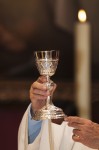
The Eucharist is celebrated daily in the parish (see here for Mass times).
In addition, the Holy Eucharist is taken out to many who are sick or housebound in our parish, sometimes after one of the Sunday Masses and sometimes on a weekday, by our Extraordinay Ministers of the Eucharist. This is an ancient and honorable practice, which was a part of the Church’s care for its members from the earliest times. St Justin Martyr describes how on a Sunday, after the Eucharist, the sacred Host “is sent via the deacons to the absent brethren”. St Tarcisius, a 12-year-old acolyte in Rome was martyred when he refused to give up the Eucharist he was carrying from the catacombs (where Mass was being celebrated in secret) to the prison where Christians were being held during one of the persecutions of the third century. He is considered a patron saint of Extraordinary MInisters of the Eucharist and of Acolytes. (Click here for more of his story)
The Eucharist is of such special significance for us, that we are encouraged to spend time in prayer before the Blessed Sacrament, the consecrated Host reserved in our church tabernacle, in adoration and praise. In our parish, there is Exposition of the Blessed Sacrament every Thursday after the 10am Mass and through the day until 6.00pm.